
Previous Residents at Columbus Addresses
Start by identifying the county that holds the Columbus parcel. Columbus stretches into Franklin, Fairfield, and Delaware counties, and the Columbus corporate-boundary layer warns that it is not a legal boundary record. A Columbus mailing address therefore may need a different county recorder or property office. In the Franklin County portion of Columbus, the trail usually moves from the current Columbus property and tax record to the Recorder, then to dated directory, census, permit, news, or probate material. None of those Columbus sources alone proves every past household.
| Source | Years it covers | Where held | What it shows |
|---|---|---|---|
| Franklin County deed indexes for Columbus land | 1804-1913 archive; modern deeds from 1/2/1914 | Columbus Recorder legacy and Cloud Search materials; counter | Grantor/grantee route, volume/page, and land-record trail |
| Columbus property and tax records | Current records; Treasurer shows tax-history choices | Auditor and Treasurer, then public counter | Columbus parcel, site identity, owner/tax trail, and conveyance clues |
| Columbus city and reverse directories | CML holdings begin 1841; address section begins 1911 | Columbus Metropolitan Library and digital collections | Columbus listed occupant or business for a specific edition |
| Columbus federal census | Released schedules through 1950 | National Archives and library genealogy access | Columbus decennial household snapshot |
| Columbus City permit and code records | Online coverage varies by record type | Citizen Access or BZS records route | Columbus address or parcel work, code, and planning chronology |
| Columbus Probate records | Marriage 1803-present; estates, guardianships, and name changes 1898-present | Franklin County Probate Court | Relationship, estate, fiduciary, or name-change leads |
Choose the Columbus source by era. A current Columbus parcel card is useful for the first deed reference. The address section in a later Columbus directory is useful for one publication year. Earlier Columbus land research changes method at the Recorder's historical-index boundary, and a released census may require Columbus address mapping before a dwelling can be located.
The Columbus Franklin County Recorder public-records guide is shown here.
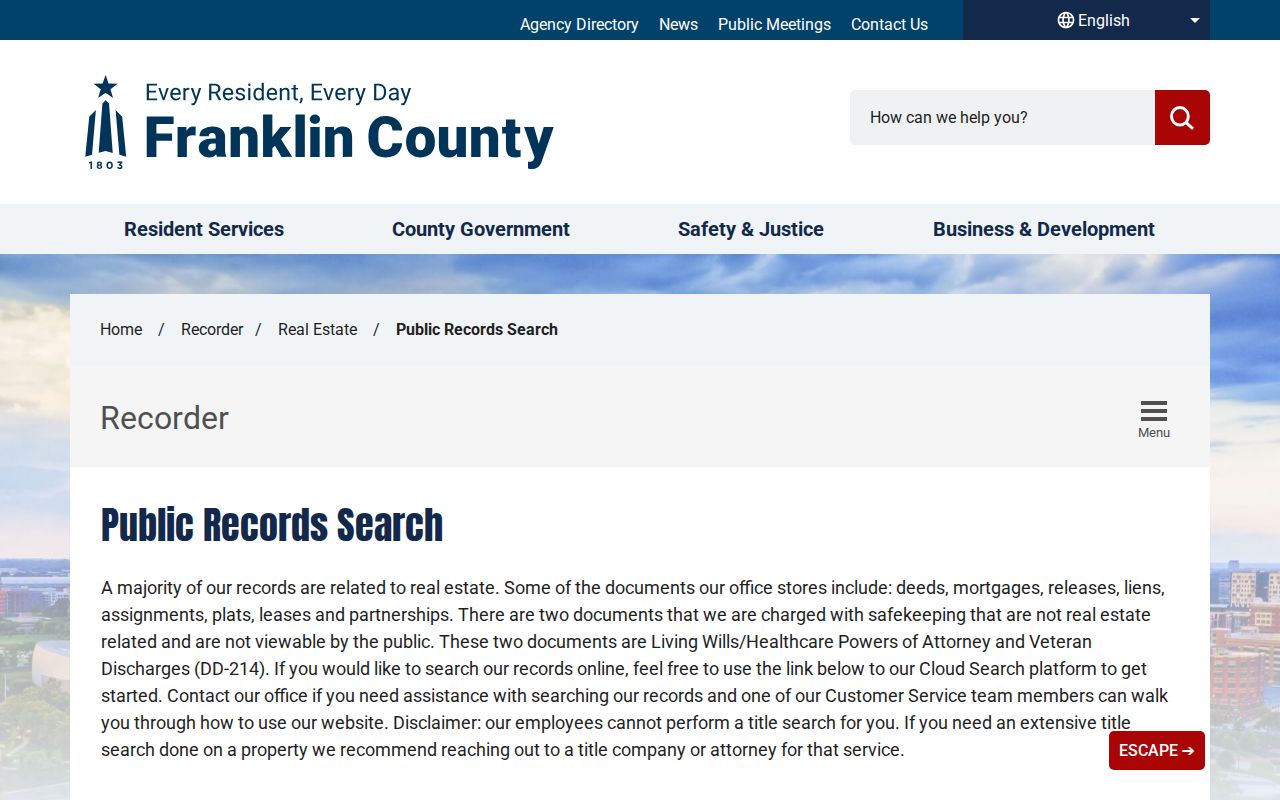
The Columbus Recorder provides both a modern search path and a separate historical-deed route, so the date of the record determines the next step.
Columbus Address Records for Past Residents
For a Columbus address in Franklin County, use the Columbus Auditor Property Search to establish the current parcel identity. The Columbus address form uses street number, direction, street name without a suffix, and unit fields. Save the exact Columbus site address, parcel number, tax district, current owner or tax identity, legal description, and latest conveyance clue. Those Columbus details let later searches survive a renamed street, a changed house number, or an older deed that does not use the current address.
The Columbus Auditor has announced a 2026 real-estate system upgrade that can make Property Search slow or incomplete. The Columbus Parcel Viewer is marked complete, and the Treasurer offers a separate search by name, street address, or parcel ID. Compare those Columbus routes and use the Auditor counter or Recorder legal-description search when a web result is incomplete. A tax mailing field or exemption indicator is not proof of who occupied a property.
Note: Preserve the Columbus legal description and parcel number before following names, because they are often steadier than a changing street address.
Columbus Previous Residents in Deed Chains
A Columbus deed chain follows recorded land parties, not a household list. Use the latest conveyance from the Columbus parcel record or Recorder search, record the current buyer as grantee and the seller as grantor, then locate the seller's earlier purchase by searching that person as grantee. Each Columbus link should retain the recording date, instrument number or book and page, the parties, and the legal description. Compare the Columbus description at every step. A similar name or a familiar Columbus street name is not a substitute for a matching land description.
- Open the current Columbus parcel record and write down the legal description, parcel number, and latest conveyance reference.
- Search the latest recorded Columbus transaction in the Recorder's index by parties, date, document reference, or legal description.
- Record the Columbus grantor, grantee, instrument or book/page, recording date, and the wording of the legal description.
- Search the prior seller as a grantee to locate that person's earlier acquisition of the same Columbus described land.
- Repeat backward until the modern Columbus index ends, then shift to the historical deed-index procedure rather than guessing across a gap.
- Grantor
- The Columbus person or entity transferring an interest in the recorded instrument.
- Grantee
- The Columbus person or entity receiving that recorded interest. In a backward chain, a prior owner is commonly found as grantee on an earlier purchase.
- Chain of title
- A dated Columbus sequence of recorded transfers affecting the same land. It is not an automatic list of every person who lived there.
- Legal description
- The Columbus lot, subdivision, metes-and-bounds, or other land description used in a record. It can bridge old documents when an address does not.
Columbus Recorder staff do not conduct title searches. Open the Columbus record, check the parties and land description, and use the appropriate custodian if a certified or complete court record is needed.
Columbus Previous Residents Before 1914
Modern deed searching has a real Columbus era boundary. The Columbus Recorder's historical guide puts modern deed-index coverage at 2 January 1914 and directs earlier Columbus research to Deed Indexes 1804-1913. Select grantor or grantee, narrow the period, enter surname initials, find the handwritten-index page, and use its volume and page to retrieve the deed. That method is more reliable than trying to force an early Columbus record through a current-address search.
The County notes that an 1879 fire destroyed some original Columbus records, although most were reconstructed. Treat the Columbus fire as a provenance warning. A missing link, a copied entry, or an unexplained difference in a reconstructed record needs to remain an uncertainty until a supporting source resolves it.
The Columbus Recorder's historical search guide is shown below.
Its Columbus handwritten-index and volume/page route is the bridge from an early name to the land books, even where a present-day address is absent.
Columbus Past Residents and Digitization
More Columbus historic material is becoming digitally available, but digitization is not a promise of a complete online chain. Columbus Recorder statistics report 33,741 documents filed before 1997 digitized in 2025, after 75,097 in 2024 and 52,350 in 2023. Those numbers describe preservation work, not a guarantee that every old Columbus book, page, image, or legal description can be found through a single name search. When a Columbus online path stops, keep the volume/page citation and ask for the actual existing record through the Recorder.
The FamilySearch catalog entry for Columbus-area Franklin County land records is shown here.
The catalog identifies Columbus-area deed books from 1801-1901 and general indexes from 1799-1920, although image and film access can vary by item.
Note: A Columbus digitized index may reveal a citation, while the underlying book, page, or original image remains the record to examine.
Columbus Reverse Directories for Past Residents
Once the Columbus property trail has a date, switch to the Columbus household layer. Columbus Metropolitan Library's house-history guide documents city directories back to 1841 and an address section beginning in 1911. The Columbus address section, or a verified Dreher reverse guide, moves from a street number to the listed occupant or business for that publication year. The alphabetical side can then add a name, initials, spouse or widow notation, occupation, or business detail where the Columbus volume uses those fields.
For years before the Columbus reverse section, start with the name side, historic maps, plats, and the legal description. Do not invent a Columbus street-to-occupant connection where the edition does not provide one. The historical volumes and their publishers are detailed in the Columbus city directory collections; use one dated Columbus address listing to test the property trail.
Columbus Previous Residents and Census
Federal named census schedules are available through 1950 under the National Archives 72-year rule. They show a household at a moment in a decennial census, not a continuous history of an address. Pair the closest available directory edition with a released census, then test the address using the street, historic map, or enumeration-district work needed for an older urban neighborhood. A match can support a dated household clue; a mismatch may reflect a move, a different address form, or a time gap.
- Choose a directory issue nearest to the released census year and preserve its edition and page.
- Use the directory address, name spellings, and any spouse notation to locate the census household.
- Compare names and address context without treating the two dates as the same day.
- Return to deeds, news, probate, or a later directory to explain a move, death, or property transfer.
The National Archives census research page appears in this image.
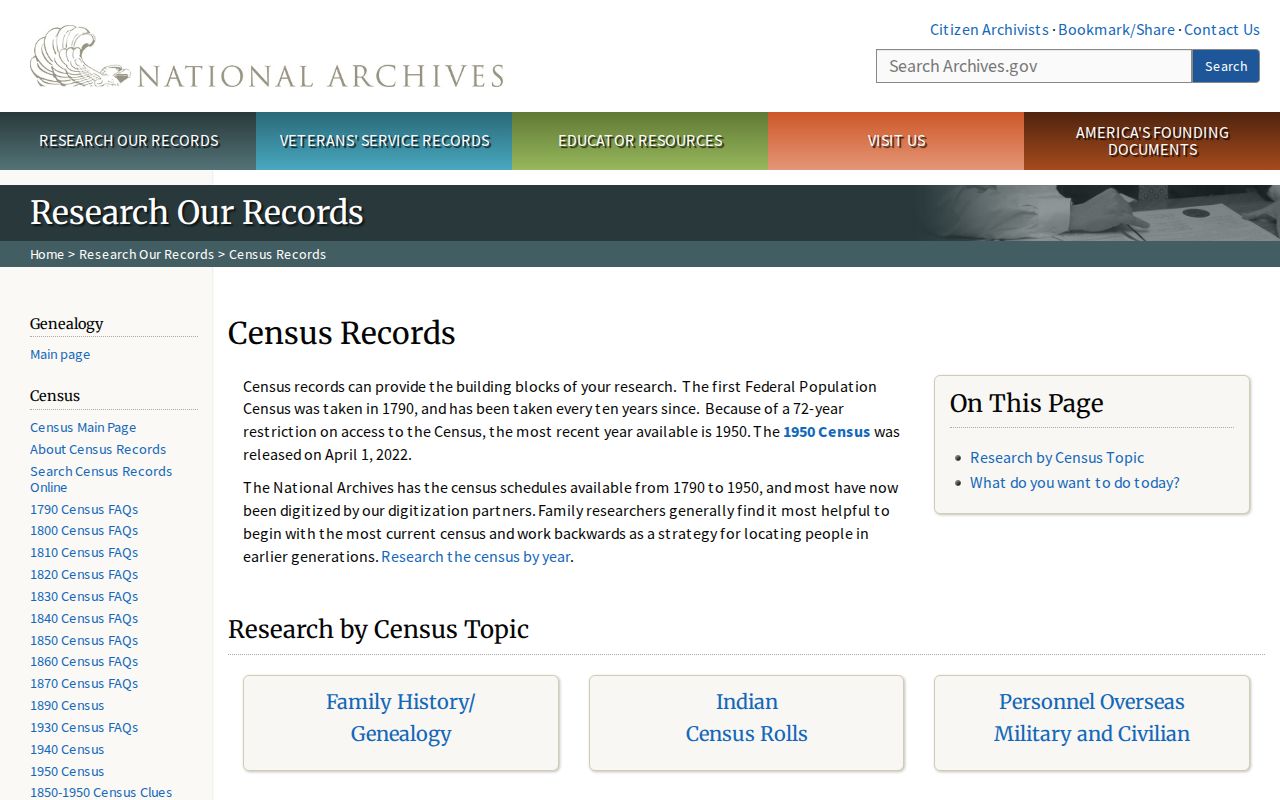
Use the federal release rule as a date limit, then let the city directory and property sources supply address detail around that census year.
Columbus Past Residents in Federal Archives
National Archives at Chicago holds federal records for Ohio that can supplement a local address trail. Its Southern District of Ohio and Columbus naturalization finding aid lists declarations for 1917-50 and petitions for 1917-47, with possible gaps. These are person-centered federal records, not a substitute for a Recorder deed book or a directory's address listing.
The National Archives at Chicago genealogy page is also shown below.
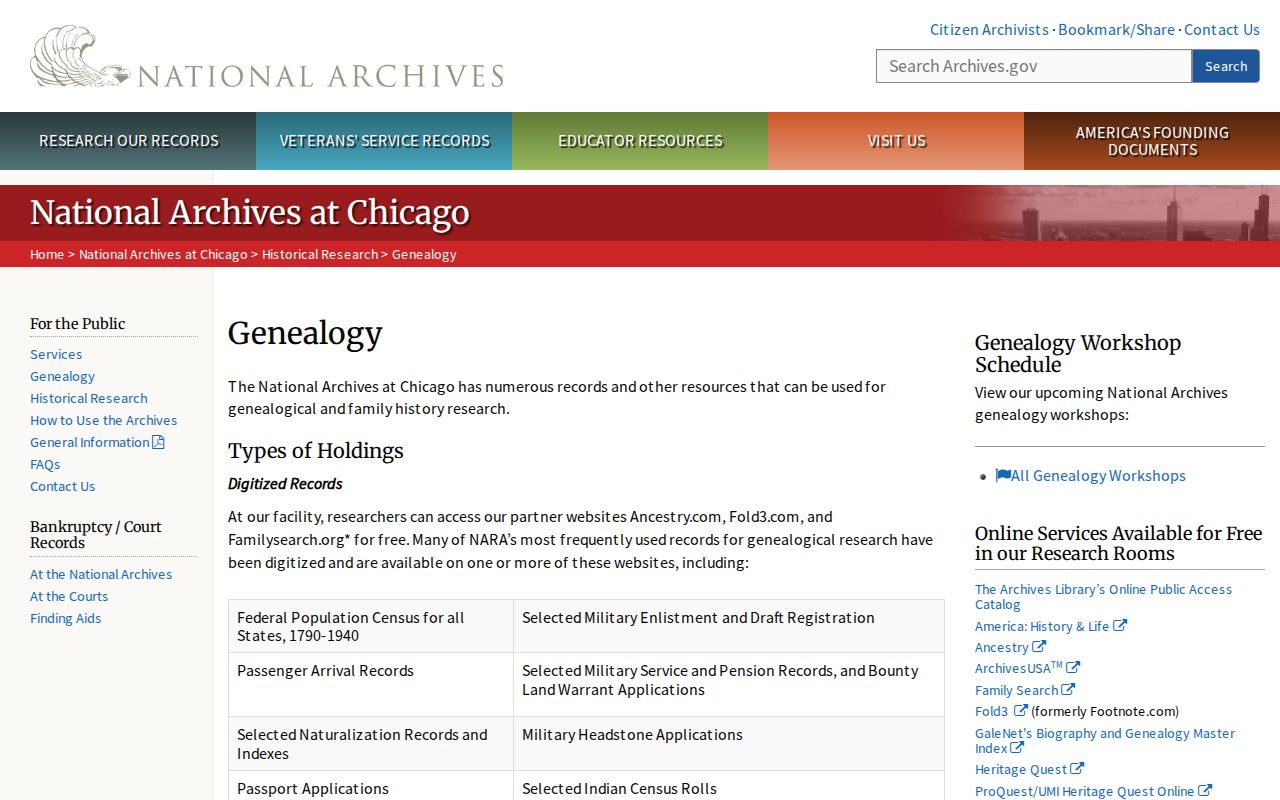
Its Ohio materials include federal records, while the county Recorder remains the first authority for Franklin County land books.
Columbus Permit Records for Past Residents
City Building and Zoning Services adds a different address-based record line. Citizen Access can search public permit, code, zoning, license, and related records by address, parcel, or record number. The City advises using a single criterion and removing an overly narrow start date when looking for older material. A permit may date work on a structure or identify a publicly listed responsible party, but it does not establish a complete household history.
When an address seems nonstandard, the BZS Map Room is the better escalation point. It assigns certified building and entrance addresses under City Code Chapter 907 and maintains street-name records. Preserve the original address form while comparing the current certified form, legal description, historic directory, and plat. Annexation or county jurisdiction can also change which records office holds the needed record.
Note: A permit date can help date work on a property, but it does not by itself identify who lived there at the time.
Columbus Probate Leads for Past Residents
A property or directory trail often ends at a death, estate, marriage, guardianship, or name change. Franklin County Probate maintains marriage records from 1803 to present and estate, guardianship, and name-change records from 1898 to present. Its general case search is current through the prior day, although some case types are confidential. A probate record may identify an estate, fiduciary, heir, or a name-change lead that explains a break in another record trail.
For local death research, CML's News and Obituary Index includes selected local-interest abstracts for 1960-97, obituary and death material for multiple historic runs, and searchable material for 1927-39. Its obituary request route can help test a dated name. Confirm land ownership separately through the Recorder, and request copies or inspect the court file through the office that holds it.
Lawful personal use. Columbus address history can support family history, estate research, or curiosity about a building. Do not use records to stalk, harass, track, or harm any living person.