
Columbus Directory Collections by Era
Columbus Metropolitan Library, or CML, is the main local shelf for historical directories. Its Local History & Genealogy collection reports Columbus directory holdings beginning in 1841, while the online collection is still being digitized. That distinction matters. A year may be held at the Main Library even when it has not yet been placed online. Printed Columbus directories generally give an alphabetical listing and an address, and many add an occupation. They identify an occupant for that edition, not a deed owner or a complete list of people at an address.
| Collection | Years | Where held | Access |
|---|---|---|---|
| Columbus City Directories | Holdings begin 1841 | CML Main Library | Physical/reference collection |
| Columbus address and reverse section | Begins 1911 | Columbus CML volumes | Address-to-listed-occupant route |
| CML City Directory Collection | Most holdings from the 1840s intended | Columbus CML Digital Collections | Free online scans; digitization in progress |
| Columbus Dreher reverse guides | 1917-18; 1929-30 | Columbus CML Digital Collections | Columbus street and house-number access |
| Telephone directories | Selected Columbus and Franklin County years | CML Digital Collections | Subscriber layer for specific editions |
The collection has verified objects from early Kinney, Williams, Lathrop's, and Greer & Co. publications, as well as later runs. Those confirmed objects do not prove that every year between them survives online. The 1944 telephone directory is particularly useful because CML says no Polk volume was printed that year.
The CML City Directory Collection is the source shown here.
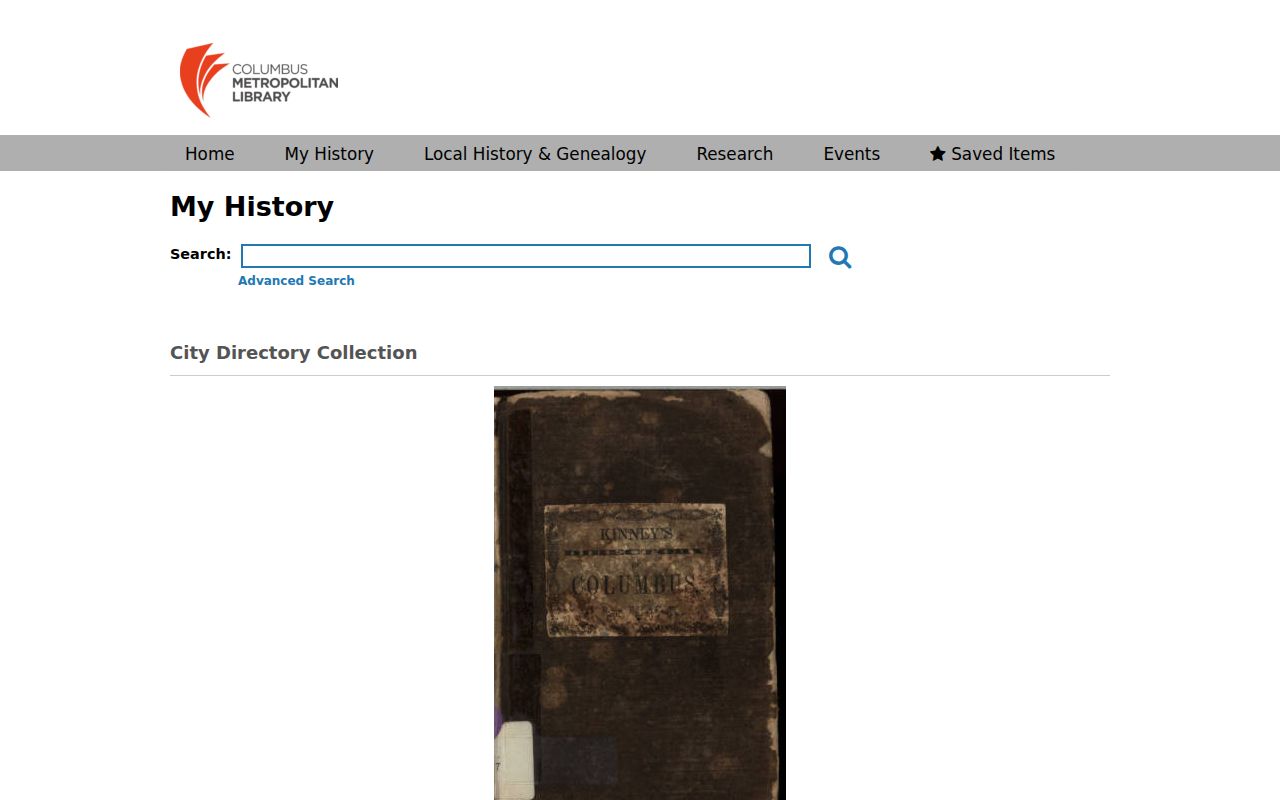
Use its year, name, street, and publisher metadata to find a scanned volume, then read the page image rather than relying only on OCR.
Columbus Library Directory Shelf
Columbus CML Local History & Genealogy is on the Columbus Main Library's third floor at 96 S. Grant Ave. Browsing does not require an appointment. The library also offers bookable one-hour consultations and remote genealogy, local-history, and house-history assistance through its published contact route. Its collection guide describes more than 85,000 books and microfilms, including directories, yearbooks, government records, neighborhood and city plans, ephemera, audiovisual material, and microfilm.
That range gives a practical fallback when a directory does not answer a question. A missing name can reflect a spelling change, an edition gap, a move, or the publication's own rules. Library staff can help locate the relevant volume or related map, but a directory entry should still be preserved with its edition year and page context.
The Local History & Genealogy service appears in this image.
The Main Library is also where print and microfilm access can fill a gap left by an incomplete online run.
Digitized Columbus Directory Runs
The Columbus digitized shelf begins with early items such as the 1843-44 Columbus Business Directory, the 1845-46 Kinney's directory, and later Columbus Williams, Lathrop's, and Greer editions. A particular object is evidence of that particular Columbus issue, not a promise of annual coverage. The Columbus online scans support full-text searching, but old type, initials, abbreviations, and imperfect OCR can hide a match. Try a surname, a Columbus street, and a likely spelling variant, then inspect the scan itself.
The digital collection also carries selected Columbus telephone directories, including 1900, 1904-08, 1910, 1915, 1926-28, 1930-31, 1933, 1935, and 1944-45. Those Columbus volumes are a subscriber layer rather than a full resident roll, but they can bridge a year where a standard directory is absent. CML specifically identifies the 1944 Columbus telephone directory as useful because no Polk volume was printed that year. Record the Columbus volume title as well as the year, since a telephone listing, a business directory, and a standard directory were compiled for different purposes.
The 1942-43 Red Book of the City of Columbus is a useful example of an accessible directory page.
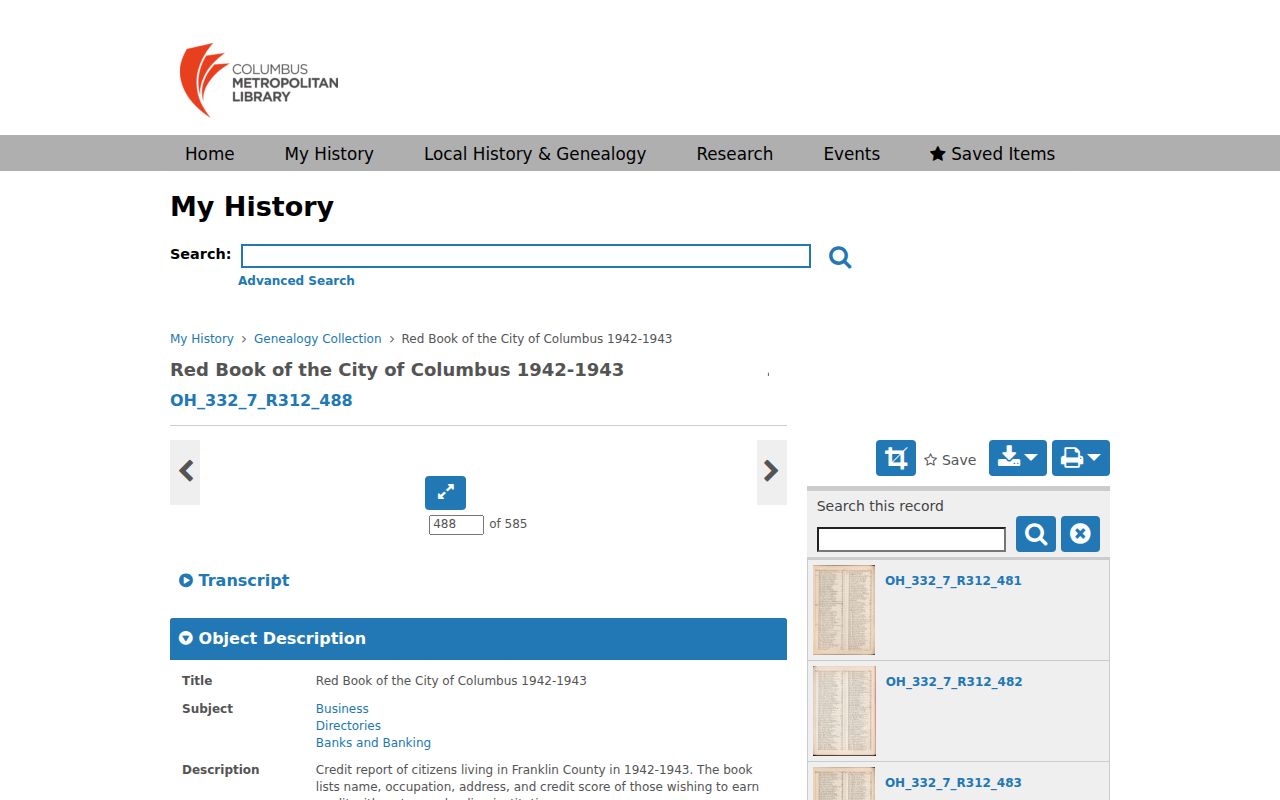
Its visible Columbus layout makes it easier to see how a surname, spouse notation, occupational shorthand, and residence were compressed into one historical line.
Reading a Columbus City Directory Entry
A Columbus directory entry has to be read as a record made for one edition. In the 1942-43 Columbus Red Book, the displayed pattern includes a surname and given name or initial, a spouse in parentheses, an occupational abbreviation, and a numbered Columbus street residence. The scan also uses wid for widow notation and sometimes carries a parenthetical racial marking. Preserve wording as printed, including abbreviations, and verify a difficult Columbus name against the image because OCR can be wrong.
| Name | Surname plus given name or initials identifies the listed Columbus person. |
|---|---|
| Spouse notation | A parenthetical name can provide a family-history lead, not a separate residency finding. |
| Occupation | Abbreviated work information can distinguish people with the same name. |
| Residence | A Columbus street number and name tie the entry to the edition's publication year. |
| Widow notation | wid is a time-specific clue that should be checked against other records. |
- Criss-cross directory
- The Columbus street-order portion of a directory that works from an address to the listed occupant or business for that edition.
- Householder index
- A Columbus alphabetical listing that points from a person or household name to the printed address.
- Abbreviation key
- The Columbus volume's own guide to shortened words and symbols. Read it before expanding a notation.
Columbus directories may help identify a person at a Columbus address. They do not establish property title. Confirm a Columbus ownership question through the county record custodian.
Note: A Columbus occupation or spouse notation is a dated directory clue, not proof that a person remained at an address.
Columbus Reverse Directory Years
The Columbus address section begins in 1911, so it is the main local path from a Columbus street number to a listed occupant for later editions. CML also documents Columbus Dreher reverse guides for 1917-18 and 1929-30. The 1929-30 Columbus guide adds a mile-square index, maps, transit information, and indexes for apartments, public buildings, churches, cemeteries, clubs, hospitals, and manufacturers. A Columbus reverse listing is an address-year snapshot, not proof of a continuous household history.
For earlier Columbus work, start with the alphabetical side, a deed legal description, historic maps, or CML's Street Location Database rather than assuming every old issue has a reverse section. A Columbus address can also change in form over time, so keep the original street spelling and number beside a modern Columbus form.
Tracing Columbus Directories for Family History
Build a Columbus household trail one edition at a time. Record the first Columbus appearance exactly, including initials, spouse or widow notation, occupation, and street address. Then compare the next available Columbus issue. A disappearance can mean a move, a changed spelling, a publication gap, a coverage change, or a death. It is not enough by itself to decide which occurred.
- Choose the closest available directory year and save the edition, page, and printed spelling.
- Check consecutive available issues for an address, name, spouse notation, or occupational change.
- For 1911 and later, use the address section or a Dreher guide to test the same location in that year.
- Pair the edition with the nearest released federal census and compare the household as a dated snapshot.
- Use a newspaper, obituary, deed, or probate record to test a move, death, or ownership question independently.
For a single property moving backward through time, the deed sequence and address-year method are developed on the Columbus previous residents page.
Columbus Directories, Census, and News
Federal named census schedules are public through 1950 under the National Archives 72-year rule. A Columbus census is a decennial household snapshot, while a directory often supplies the years between those snapshots. Pairing them can reveal whether a Columbus household had the same address near a census year, but Columbus census address work in older urban areas can require maps or enumeration-district research.
The CML News and Obituary Index is shown in this image.
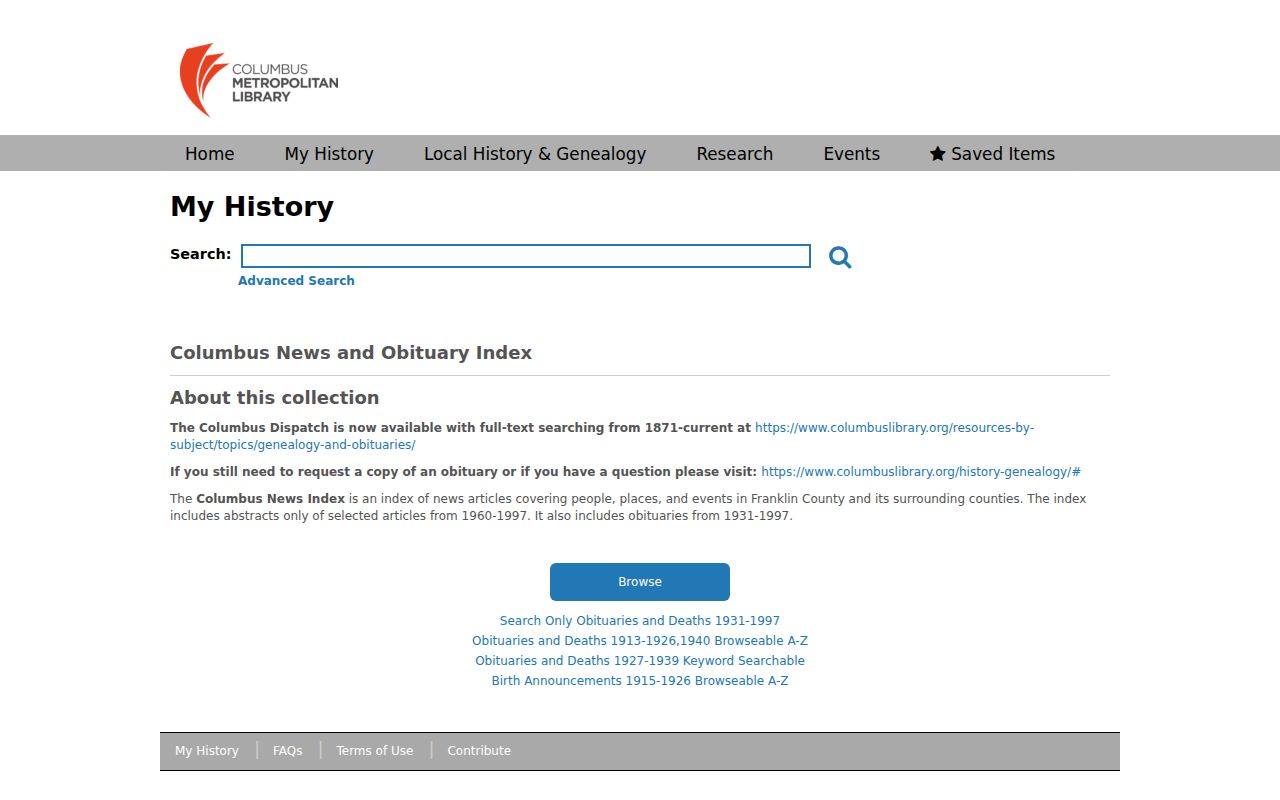
The index offers selected local-interest abstracts for 1960-97, obituary and death material for several historic runs, and birth announcements for 1915-26. It can test a dated directory lead without turning one listing into a broader claim.
Note: A census or obituary supports a particular date and record type, not an unbroken account of every year between records.
Columbus Directory Leads and Obituaries
When a Columbus address or spouse notation points to a possible death, CML accepts up to six free obituary requests per month through its published form. The request asks for the deceased person's name and contact email, with date, newspaper, page, and additional-information fields when known. CML says most replies arrive within 48 hours, excluding Sundays, holidays, and closures. Use the Columbus directory edition to narrow the request, then treat the returned notice as a separate source.
The CML obituary request form is the source shown below.
A concise request with a name and likely time period gives the library a clearer starting point than an undated family story.
Columbus Directory Shelf Since 1841
The physical directory shelf begins in 1841, while the first verified digitized object is 1843-44. That gap between holding dates and online objects is an important Columbus records story. Directory research may need both the online collection and a Main Library visit or consultation. Columbus Historical Society adds specialized and neighborhood holdings, though its general collections are temporarily closed during the Engine House No. 6 and storage transition and access is by appointment.
The Columbus Historical Society collections page is shown here.
This is a useful archival fallback for a specialized subject, while CML remains the primary starting shelf for Columbus directory research.
- 1841: CML's physical Columbus directory holdings begin.
- 1843-44: the first verified digitized Columbus directory object appears in the CML collection.
- 1911: the standard directory's address section begins.
- 1944: a telephone directory supplies a useful substitute because no Polk volume printed that year.
Note: The online directory dates and the library's physical holdings are separate coverage questions, so verify the needed edition before travel.